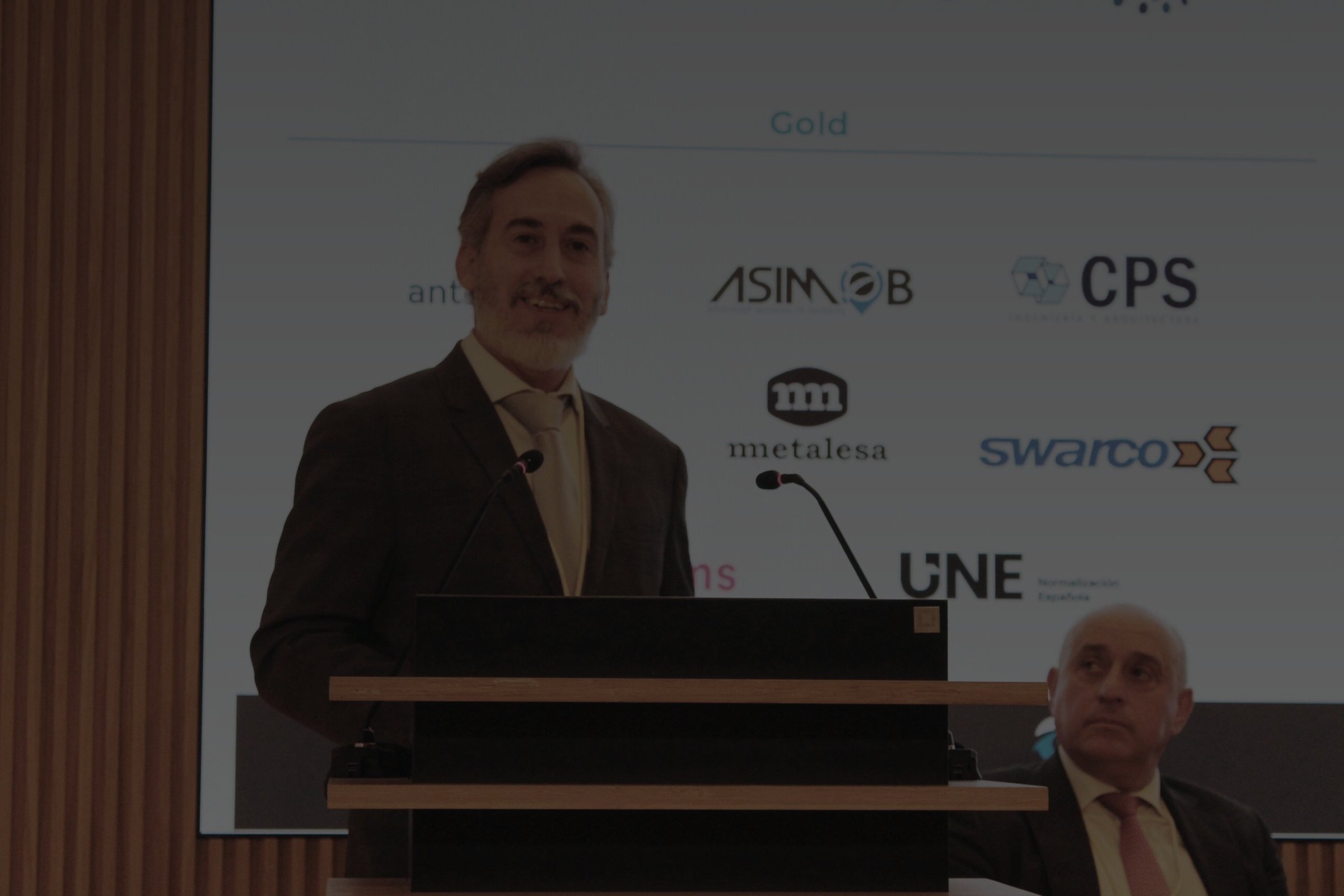
Miguel Carpio, DS4MM coordinator, explained in Madrid how federated data spaces can advance intelligent transport systems, during a session entirely dedicated to data spaces.
On 13 and 14 October, the Madrid College of Civil Engineers hosted the 5th Spanish Smart Roads Congress, organised by the Spanish Road Association (AEC). The two-day event explored the progress of road digitalisation: from national access points for traffic data to asset management, road safety and preparing roads for autonomous vehicles.
This year, data spaces had a dedicated session, “Data spaces: lessons learned and next steps”, and DS4MM took part.
Breaking down silos
Miguel Carpio, DS4MM coordinator, took part in the session with a presentation entitled “Breaking the silos: how federated data spaces are fuelling ITS”, before an audience of close to one hundred people.
The starting point was the same challenge driving our project: roads already generate a wealth of data (traffic, incidents, weather, occupancy of service areas and equipment), but these data are distributed among public authorities, concession holders, operators and technology companies, each with their own formats and rules. A federated data space makes it possible to connect them without centralising them: each organisation retains control of its data and decides who can access them and under what conditions.
Trust at the heart of it all
Miguel emphasised one idea: in a data space, trust is not a feature added at the end but the foundation on which everything works. To explain this, he began by clarifying what a data space is not. It is not an open-data model, because it can include sensitive data. It is not an API, because it supports many types of connectors. And it is neither a data lake nor a data warehouse, because it does not store the data themselves: it stores the metadata that make them discoverable.
From that starting point, he outlined three principles:
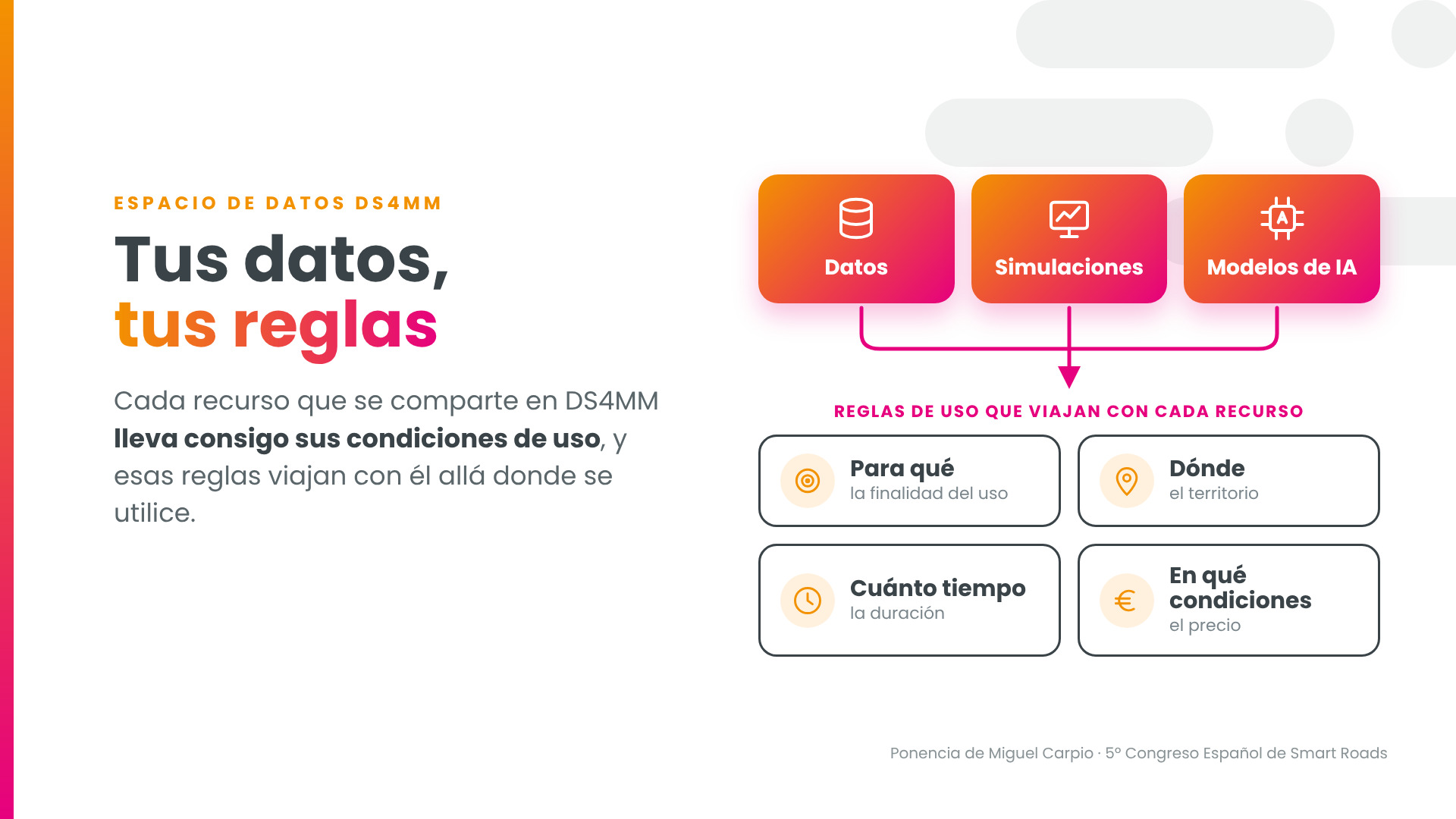
Every resource, whether a dataset, simulation or AI model, comes with its own conditions of use: permitted purposes, geographical scope, duration and price.
A catalogue validates metadata and publishes them so that others can discover the resources. By building on standards such as DCAT-AP, the solution can work across different regions and programmes rather than serving as a one-off local fix.
Federated storage and secure execution mean that sensitive data do not need to “leave home” in order to create value.
A real-world use case: winter road operations
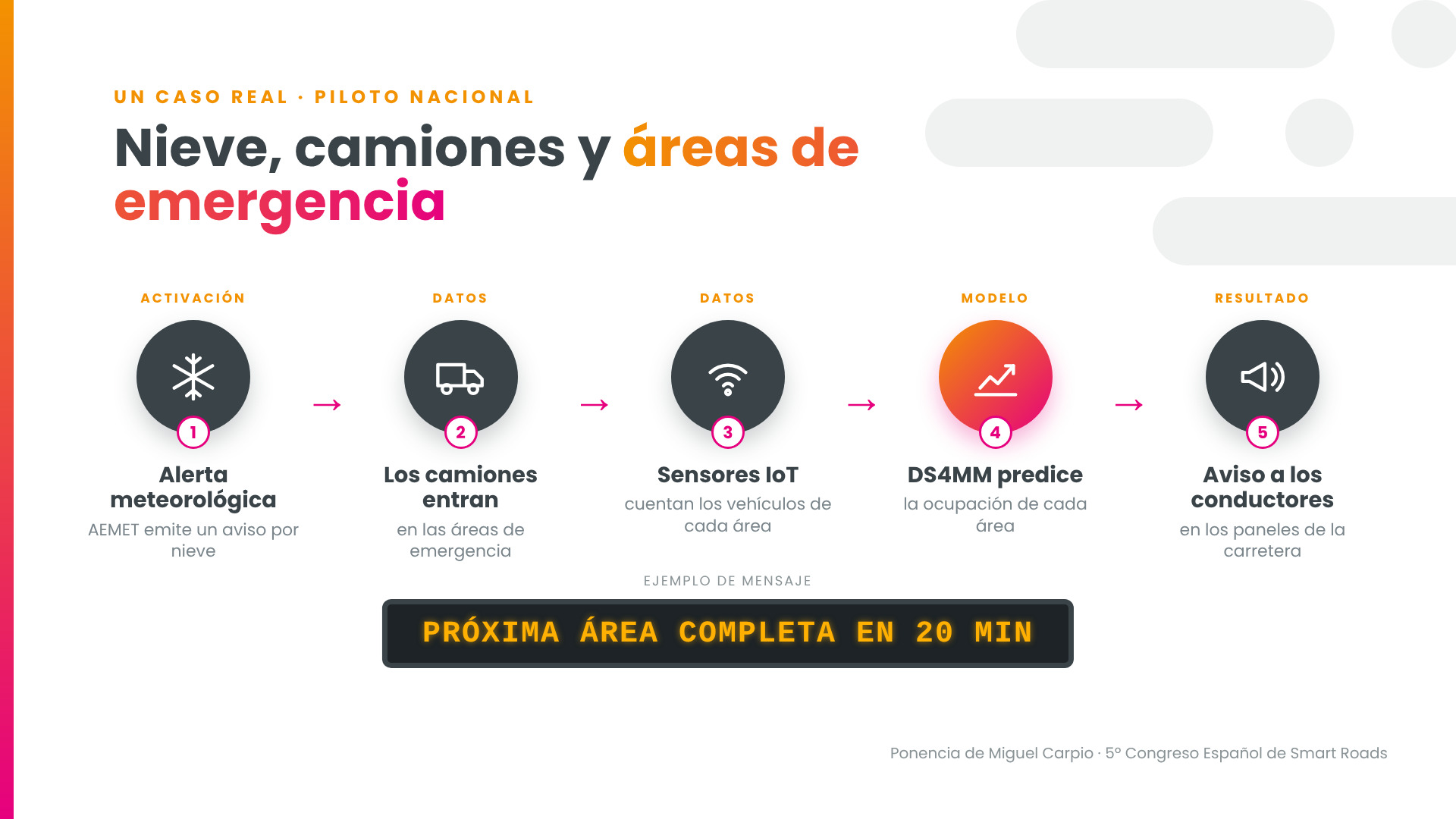
Miguel argued that the important issue is not the technology itself but how use cases solve real problems. He illustrated this with one of the use cases in DS4MM’s national pilot: managing emergency parking areas for trucks during snowfall alerts. It shows how open data can be combined with data from different organisations to anticipate road conditions and support decision-making.
A session bringing together different perspectives
The session brought together different perspectives on a shared challenge: the road towards a national mobility data system; lessons learned from other data spaces; standards applied to mobility; the role of data in infrastructure resilience to climate change; and AECTech, the road data space promoted by the AEC.
This was not the consortium’s only appearance at the congress. Javier Tarriño, Innovation Coordinator at CPS, a DS4MM partner, presented RODA (Road Operations & Data Analytics), CPS’s data platform, during the session on innovative road safety solutions.
- Data spaces have moved beyond the conceptual stage and now have their own dedicated session at Spain’s leading smart roads forum.
- The challenge is no longer only technological: it also calls for common rules, standards and trust between data providers and users.
- Dialogue among national, sectoral and European initiatives is essential if data spaces are to avoid becoming isolated.
Find out more
Speakers’ presentations AEC TV photo gallery
Thank you to the Spanish Road Association for inviting DS4MM to participate in the congress.