On 7 October we brought together researchers, technology companies and mobility managers at Digitaliza Madrid to talk about something very specific: what it takes for mobility data to support better decisions. These are the ideas we took away.
One idea came up, in different words, in almost every talk: the problem is no longer having data. There is data, and more of it every day. The challenge is to connect it, understand it and turn it into timely decisions.
That was the idea behind Data4voices, “From data to connected mobility”: a morning to listen to people who work with mobility data every day and to explain, plainly, where we stand.
Where DS4MM stands today
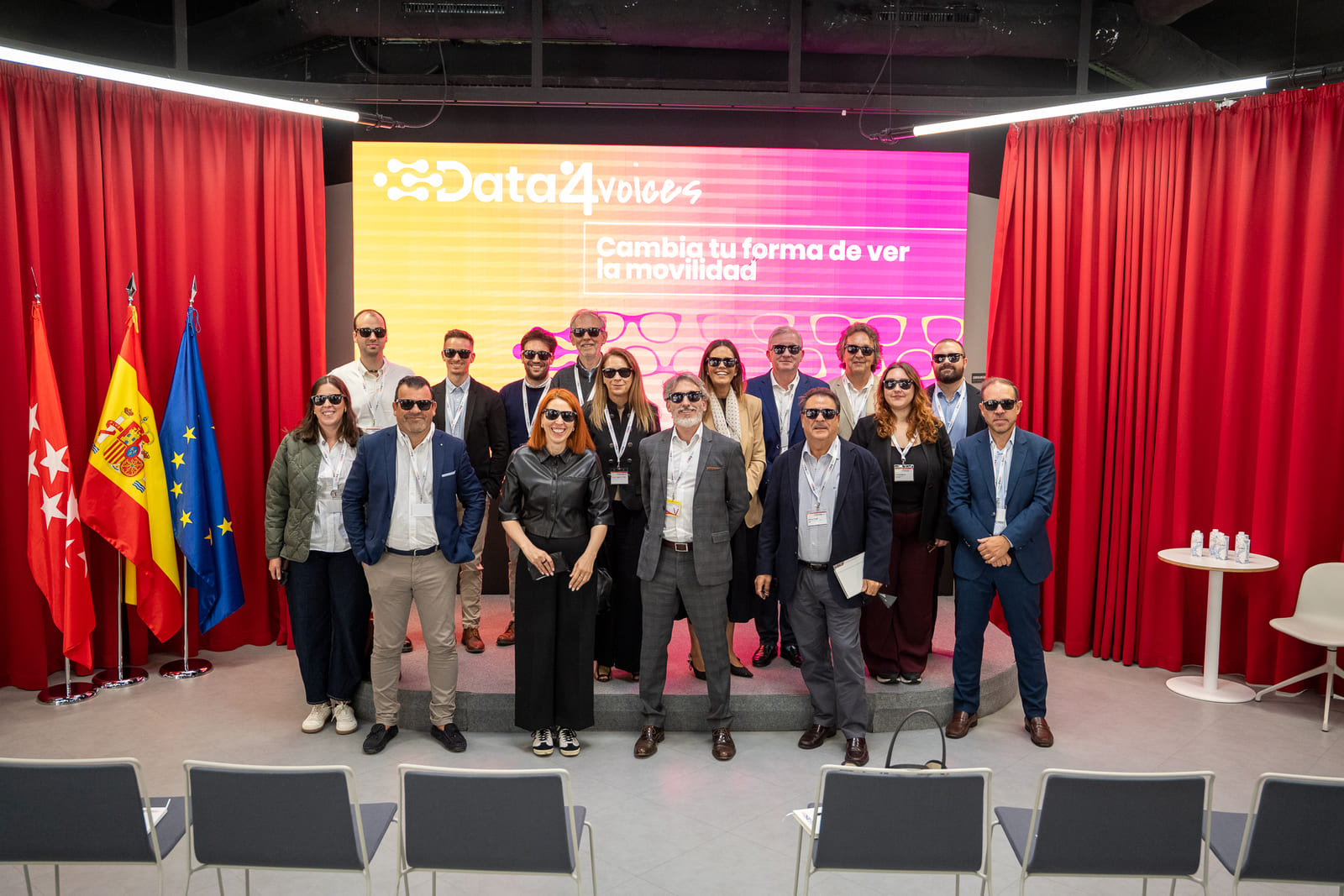
We opened the event with a snapshot of the project. We have completed the design phase, in which we defined use cases, data, governance and architecture, and we are now building. At the end of 2026 the data space will enter its testing phase with real data from the pilots, and in spring 2027 we will validate the results.
What we deliver in May 2027 aims to be a practical proposal for how the Integrated Mobility Data Space (EDIM), created by Spain’s Sustainable Mobility Act, could work. It is no longer about explaining what a data space is, but about proving that it works.
What the speakers told us
Planning starts with understanding people
Andrés Monzón, Professor of Transport Engineering at the Universidad Politécnica de Madrid (TRANSyT), opened the talks with a reminder of something we sometimes take for granted: good planning requires understanding demand. And demand is not just trips that can be counted. It is people’s decisions, shaped by their habits, their expectations and their reasons for choosing one mode of transport over another.
He took us from data to information, from information to knowledge and from knowledge to decisions. New sources such as connected vehicles, mobile phone trajectories and image-based traffic counts multiply what we can measure. But they do not replace surveys, which remain essential to understand why we travel the way we do.
One border, three countries and a common data language
The cross-border pilot is probably the best example of what a data space is for. Isidro Arrieta, founding partner of Ingartek, explained the starting point: data from Spain, France and Portugal with different formats, frequencies and identifiers, spread across administrations with overlapping responsibilities. His team harmonises it without losing the link to the original source, so that each piece of data still shows where it comes from and what its limitations are.
Antonio Pellicer, senior researcher and project manager at Aimsun, showed what can be done with that data next. He distinguished between simulation models, which answer “what would happen if…?”, and data-driven models, which answer “what is going to happen?”. They do not compete: they complement each other. On the corridor between the Basque Country, Navarre and France, the aim is to anticipate congestion one hour in advance and to measure CO2 emissions per section, using the same indicators on both sides of the border.
Getting ahead of the snow
Miguel Carpio, DS4MM coordinator at EYSA, and Javier Tarriño, Innovation Coordinator at CPS, brought the data space down to a very familiar problem: what to do with lorries when there is a snow alert. Today they can be diverted to emergency parking areas, but the key question is a different one: will there be space when they arrive?
The use case combines open data, such as the road network, incidents, weather and the catalogue of parking areas, with traffic data and data from variable message signs. With these, the model estimates when each parking area will fill up and recommends, on each sign, the ones that will still be below 80% occupancy at the expected time of arrival. We move from a generic warning to a message that helps drivers decide: for example, that the next parking area will be full in 20 minutes.
The challenge is not having more data
From NTT DATA, Carme Moreu Alfós and Juan Carlos Fernández named the underlying problem: we have more data than ever, yet it is still hard to use together. A single piece of data is worth little on its own. Value appears when we connect it, give it context and turn it into decisions.
They also clarified something worth repeating: a data space is neither a large centralised warehouse nor an open API. It is a governed, interoperable environment in which each organisation keeps control over its data and decides who it shares it with and for what purpose.
From data to model, and back
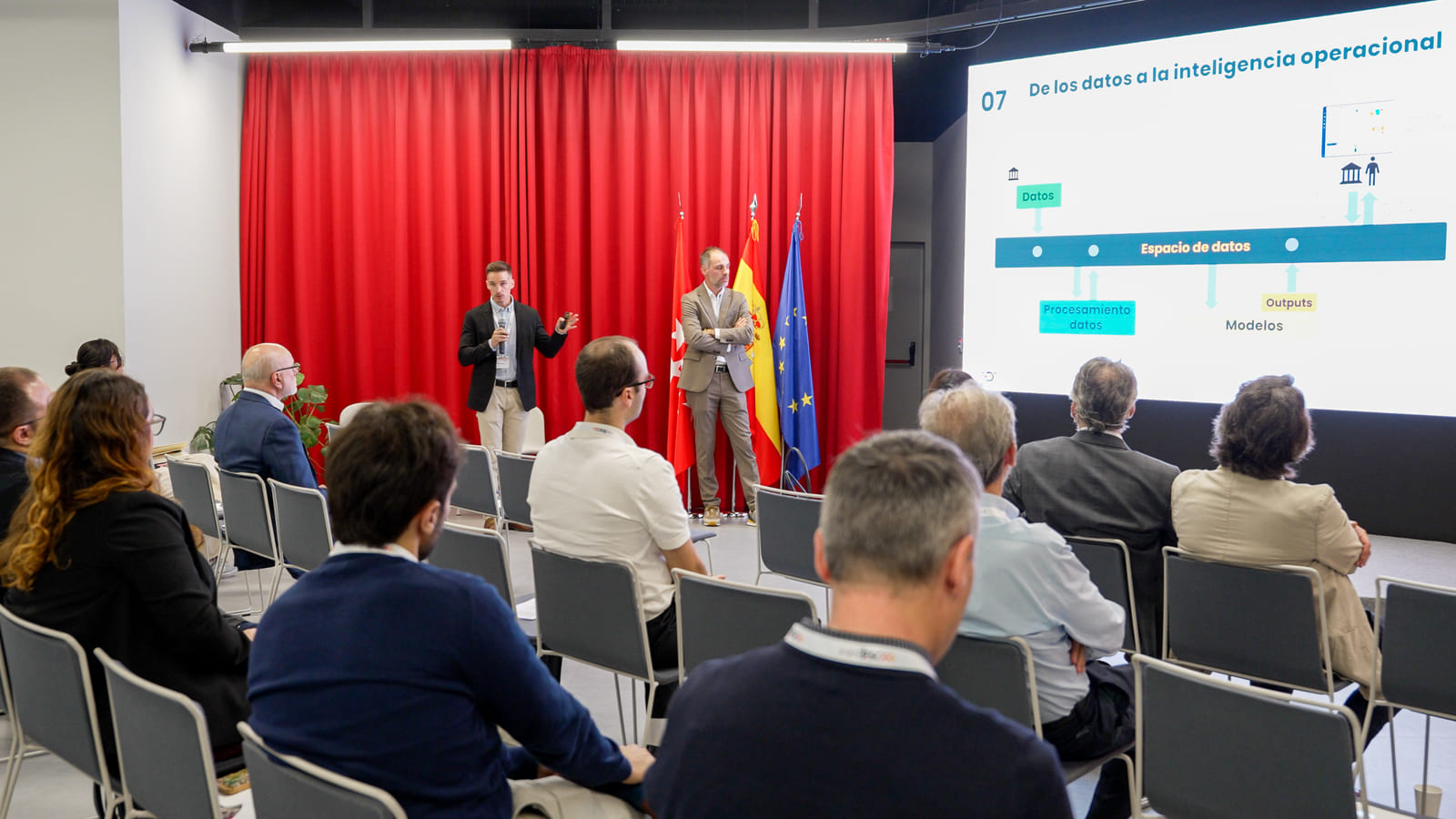
Before the round table, Antonio Pellicer and Carme Moreu Alfós walked us through the whole process, end to end: a provider offers its data in the data space, a model uses it with permission, and the results go back into the data space so that other authorised stakeholders can reuse them. It is, on a small scale, the logic of the whole project.
Artificial intelligence up for debate
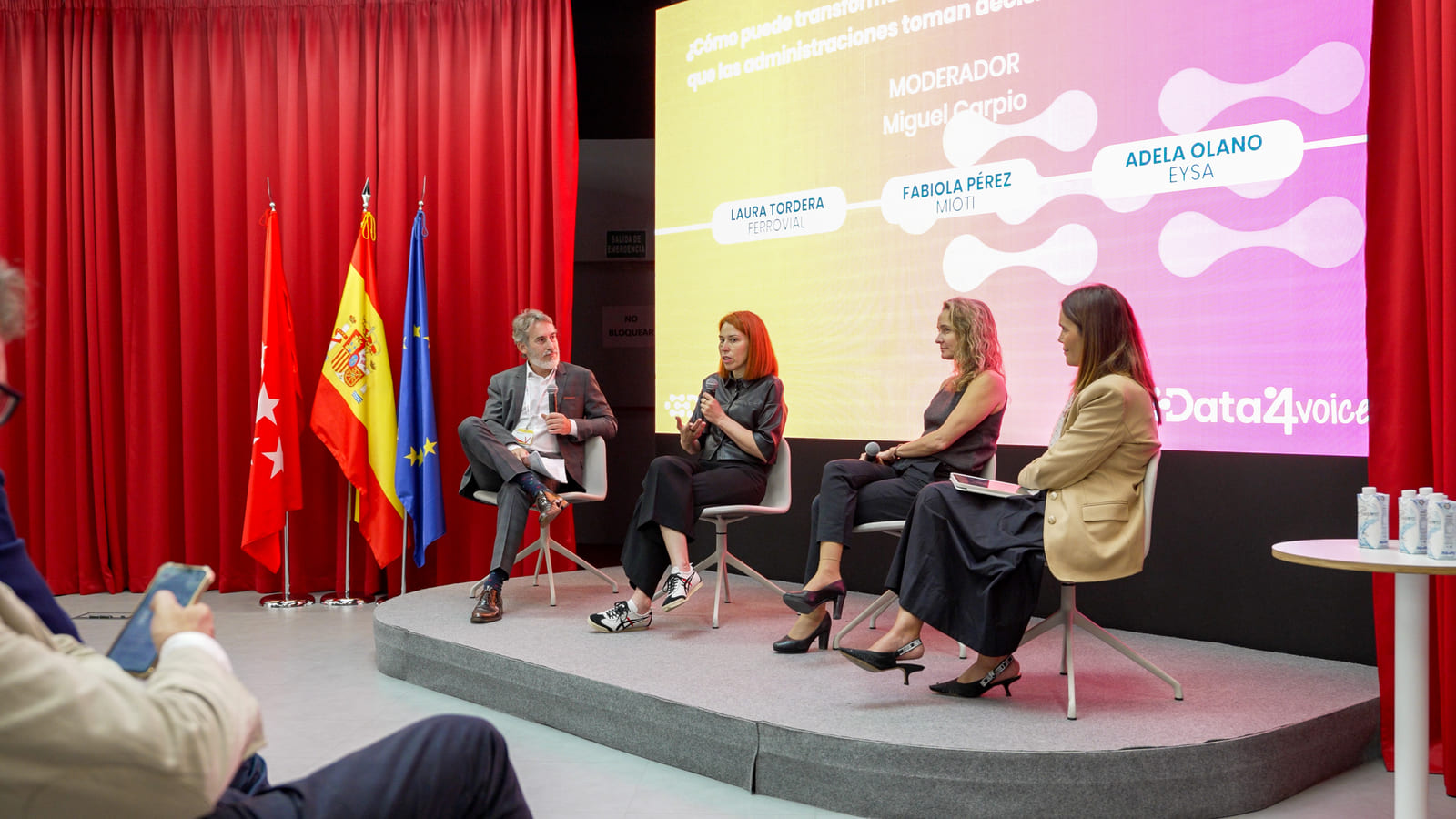
We closed with a round table on a very topical question: how can artificial intelligence transform the way public administrations make mobility decisions? It was moderated by Miguel Carpio around an original thread: imagining the daily work of a civil engineer who, a few years from now, manages a large city’s traffic from its control centre with an AI assistant by her side.
Fabiola Pérez, CEO of MIOTI, argued that AI, used well, complements professionals: it shortens the learning curve for newcomers and helps ensure that the knowledge of the most experienced staff, the kind that was never written down, is not lost. For her, the debate is no longer only about data but about knowledge: who has it, how it is shared and who it belongs to.
Laura Tordera, Global Head of Innovation & AI at Ferrovial, took the conversation to the field of infrastructure. Generative AI is already entering design, and digitalisation means that client, contractor and subcontractor increasingly work on the same information. She also warned of a growing gap between those who understand AI and those who are left behind, and of the need to start thinking now about its social effects.
Adela Olano, ESG Director at EYSA, focused on sustainability. AI also leaves a footprint, for example in the energy and water consumed by data centres, and we need to measure not only what it costs but what it achieves, such as the emissions it helps to avoid. She also stressed that the transition has to be fair, with training so that no one is left behind.
At DS4MM we are clear: without shared, high-quality and well-governed data, artificial intelligence will hardly be useful for the public management of mobility.
Five ideas we took away
- There is data. The challenge is to use it together. The bottleneck is not generating more information, but connecting it with rules and trust.
- To plan, you have to understand people. Counting trips is not enough: we need to know why we travel the way we do.
- Interoperating is not standardising. Data from different countries can be harmonised without losing where each piece comes from or its limitations.
- Anticipating instead of reacting. One hour’s warning of congestion, or knowing that a parking area will be full in 20 minutes, changes the way traffic is managed.
- Simulation and data complement each other. Some models help to assess scenarios that have not yet happened; others help to forecast what is about to happen.
Thank you
Thank you to Miguel Carpio, Andrés Monzón, Isidro Arrieta, Antonio Pellicer, Javier Tarriño, Carme Moreu Alfós, Juan Carlos Fernández, Laura Tordera, Fabiola Pérez and Adela Olano for sharing their knowledge so generously. Thank you to everyone who joined us, for your questions and for the conversations that continued over networking. And thank you to Digitaliza Madrid for opening its doors to us.
This does not end here. In the coming months we will keep sharing progress from the pilots and the best of the talks. If you want to stay up to date, subscribe to our newsletter.